
 Inquiry

 English
 中文简体
中文简体 Deutsch
- Type:
- News
- Date
- 2026-Sep-07
News
Pet Cage vs Playpen: Which One Does Your Pet Really Need? | Nantong Dihang
Content
- 1 Pet Cage vs Playpen: What Each Design Actually Does
- 2 The Real Difference Is Behavioral, Not Just Physical
- 3 Space, Sizing, and Your Floor Plan
- 4 Travel and Portability: Where the Cage Pulls Ahead
- 5 Heavy-Duty Considerations for Large Chewers and Outdoor Use
- 6 Pet Cage vs Playpen: A Quick Decision Framework
- 7 Why Material and Build Quality Matter in Both Options
- 8 Frequently Asked Questions
A 10-week-old Labrador retriever has just landed in your kitchen. Within 48 hours, you will face the pet cage vs playpen decision, and that single choice will shape house training results, furniture protection, and your daily routine for the next decade. This comparison is not about which design is newer, it is about which one matches the specific job you need done.
Pet Cage vs Playpen: What Each Design Actually Does
Both a metal pet cage and a metal pet playpen can contain a dog, cat, or rabbit. What changes is the job they are asked to perform.
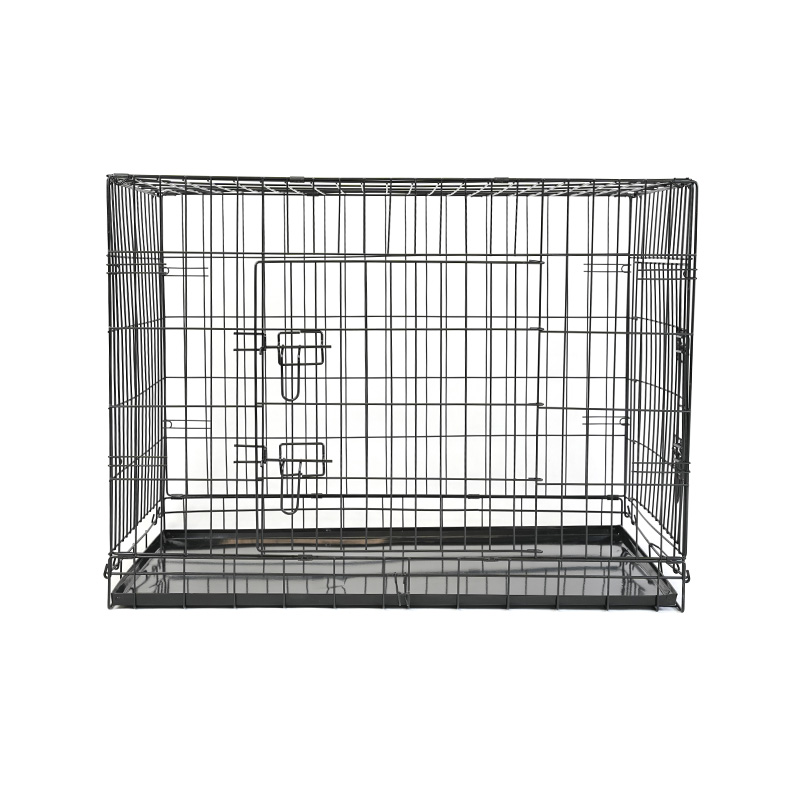
Definition: A metal pet cage is a rigid, usually rectangular containment structure designed for rest, travel, and habit formation. A metal pet playpen is a modular, multi-panel containment structure that creates a designated activity zone without restricting movement within its bounds.
A cage compresses a pet's options. It creates a small den that triggers a natural instinct to keep the sleeping area clean. A playpen expands a pet's options. It lets the animal stand, turn, walk three or four steps, and choose where to lie down.
The practical result is simple: a cage is a room, and a playpen is a yard. Both are built from welded metal, both fold for storage, and both come in regular or heavy-duty versions. But you will not use them in the exact same situation, because they solve different problems.
- A cage is best for short, focused periods: sleeping, traveling, and house training.
- A playpen is best for longer unsupervised time: when you are at work or your dog needs to move.
- A cage has a solid floor that catches food and water spills.
- A playpen is open to the floor, so you need a surface that is easy to clean underneath.
The Real Difference Is Behavioral, Not Just Physical
If you are trying to stop accidents, a cage wins. If you are trying to prevent furniture destruction, a playpen wins. This is not a preference debate, it is about what the dog's brain does inside each structure.
House training works because a puppy will not voluntarily soil a small sleeping space. The same puppy will happily mark the far corner of an eight-panel playpen, because the playpen does not trigger the same den instinct.
4h
Max continuous crate time for adult dogs
2h
Max continuous crate time for puppies under 6 months
8h
Safe continuous playpen time for most adult dogs
Why cages work for house training
Use a cage for the first eight weeks. The metal crate creates boundaries that teach the dog to hold its bladder. Once the dog consistently goes 8 hours without accidents, you can move that same dog to a playpen for longer unsupervised periods.
Why playpens work for activity time
Use a playpen for the daytime hours when nobody is home. A 6-panel or 8-panel metal playpen gives the pet a water bowl, a bed, and enough floor space to walk and stretch. This matters for adult dogs and for young dogs that are still growing.
- Stress response: a properly crate-trained dog relaxes in a cage; a dog that needs to pace relaxes in a playpen.
- Accidents: a cage prevents them; a playpen does not prevent them.
- Destructive chewing: a cage removes access to furniture; a playpen gives the dog room but still controls the space.
Space, Sizing, and Your Floor Plan
A cage occupies one fixed square on your floor. A playpen can be wrapped around a sofa, tucked against a wall, or split across two corners.
In an apartment, the playpen's modular nature is a real advantage. You can use four panels to make an L-shaped fence that keeps a dog out of the hallway, while the same fence in the yard can be six or eight panels long. Sizing is the practical reason many mixed households end up with both products.
Cage vs playpen: score by use case
Metal pet cage Metal pet playpen
House training
Movement freedom
Portability
Multi-pet expansion
Cleaning ease
| Criterion | Metal Pet Cage | Metal Pet Playpen |
| Fixed footprint | Single rectangle | Configurable polygon |
| Typical floor area | 2-8 sq ft | 12-32 sq ft |
| Portable and folding | Yes, folds flat | Yes, folds flat |
| Indoor use | Very common | Very common |
| Outdoor use | OK with cover | Best for outdoor |
| House training | Strong support | Weak support |
| Multi-pet enclosure | Not applicable | Useful with 6-16 panels |
Square-tube frames are stronger at the corners than round-tube frames. This is the first thing to check when comparing playpen models from different suppliers.
Travel and Portability: Where the Cage Pulls Ahead
For car rides and hotel stays, a folding metal pet cage is the practical choice.
The cage folds flat, has a carry handle, and locks into a trunk or cargo area. A playpen can be folded too, but even a compact 6-panel playpen takes up more floor space when assembled and is harder to secure in a car.
If your routine involves weekly visits to a friend's house, or a cross-country road trip, look for a foldable metal dog crate with rounded corners, a removable tray, and a secondary door. The door placement matters: double-door crates are easier to fit into a front or rear seat area.
Double-door crates are easier to fit into a car because the pet can enter from the side that faces you.
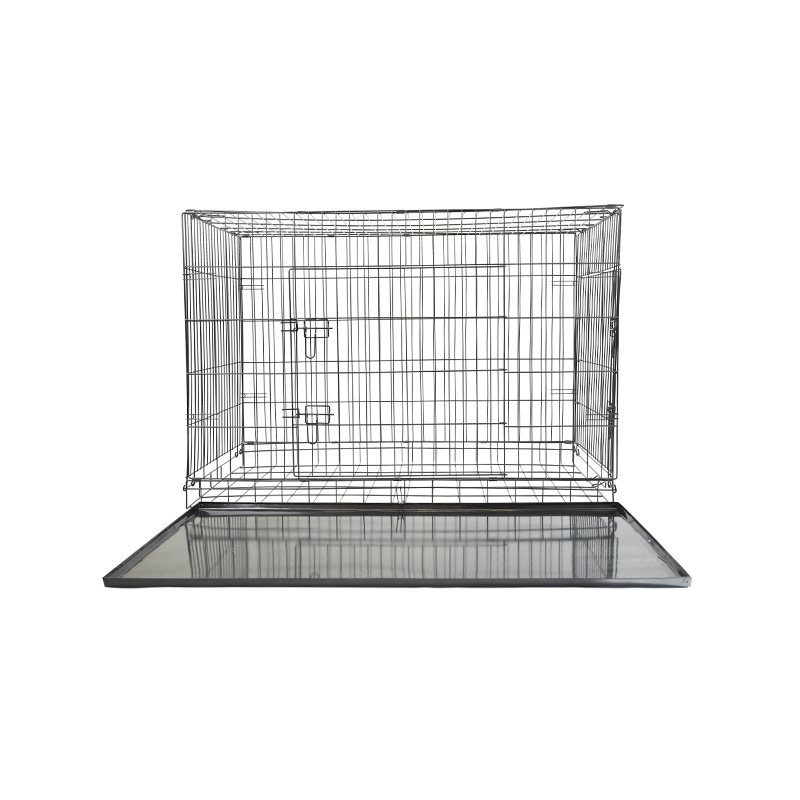 Foldable Portable Metal Dog Crate for Travel and TrainingThis foldable crate offers easy transport and storage, making it suitable for car rides and home use. Its steel construction provides durability, though larger breeds may require a heavier gauge.View Product →
Heavy-Duty Considerations for Large Chewers and Outdoor Use
Routine chewers will test any metal, and large breeds need heavier gauge steel and welded corners.
A standard metal pet cage can be pushed and pried apart by a determined power chewer. A heavy-duty version uses thicker bars, reinforced door latches, and often a solid steel or ABS tray.
For dogs that live primarily in a yard, a heavy-duty outdoor playpen is the more durable option. Outdoor enclosures face constant humidity, UV exposure, and dirt. Panels with an anti-rust coating and a square-tube frame will outlast thin-gauge alternatives by several seasons.
Anti-rust coating is not a nice-to-have. It is the reason an outdoor playpen can stay in the yard year-round.
A heavy-duty metal dog cage with an ABS tray is a solid choice for a breeder or a multi-dog household. The tray pulls out for cleaning, and the double-door design lets a breeder move a dog in and out without opening the front panel fully.
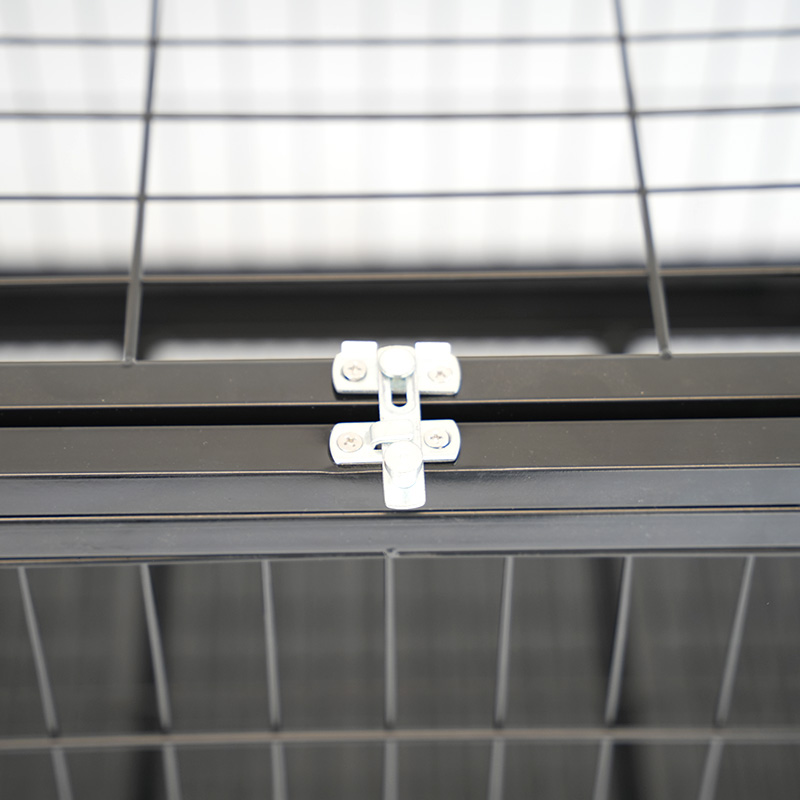 Heavy-Duty Metal Dog Cage with Removable ABS Tray and Double DoorsDesigned for multi-dog households or breeders, this cage features a pull-out ABS tray for easy cleaning and double doors for convenient access. Its sturdy metal build withstands active large dogs.View Product →
Pet Cage vs Playpen: A Quick Decision Framework
Match the structure to the hours you are actually away.
Puppy under 6 months Metal pet cage for house training.
Adult dog, no destruction history Heavy-duty playpen with a gate.
Multiple pets, limited floor area 8-panel metal playpen in an L-shape.
Rabbit or cat Playpen with high panels and a net.
The frame itself matters too. A playpen with a gate is safer for you, because you do not have to step over the fence to refill water. A hexagon or a rectangle can be formed from the same panels, depending on whether you are creating a corner zone or a free-standing enclosure.
If you have a treadmill or a giant exercise wheel, the playpen can be the safety buffer around it.
 8-Panel Portable Indoor Metal Dog PlaypenThis playpen provides a secure, flexible area for indoor exercise and can serve as a safety buffer around equipment like treadmills. Properly welded panels ensure long-lasting durability.View Product →
Why Material and Build Quality Matter in Both Options
The lifespan difference between a cheaply built cage and a properly welded one is not months, it is usually 3 to 5 years.
Raw material selection, weld quality, and anti-corrosion coating decide whether a metal pet cage survives a decade or fails in the first season. From a buying perspective, focus on three things: bar thickness, weld finish, and hinge strength. A heavier bar gauge is not always better for a small breed, but it is essential for large dogs. The weld finish tells you whether the frame will crack under repeated folding. Hinge strength determines how quickly a door becomes a way out.
Nantong Dihang Metal Products Co., Ltd. runs a quality process that tests metal raw materials on the way in, inspects welds and surface treatment during production, and completes corrosion and chew resistance tests on finished products before shipping. For importers, distributors, and contract manufacturers who need consistent output across a large order, this matters more than a single perfect sample. The company provides OEM service and more than 100 standard pet cage and playpen models, so a buyer can order a tested design or customize a frame.
One question that comes up constantly in wholesale enquiries is whether a playpen can be used on a balcony or in a garden. The answer depends on panel height and weight. A 30-inch panel works for small breeds, but a 40-inch panel is preferable for a dog that can jump. When you buy from a manufacturer, ask about the actual wire diameter and whether the tubes are square or round. Square tubes are stronger at the corners and hold their shape better under repeated use.
If you are still deciding, read this guide on choosing the right pet playpen before you place an order.
Frequently Asked Questions
Can a metal pet playpen be used indoors for a puppy?
Yes, an 8-panel metal pet playpen can be used indoors. For a hard floor, choose a design with rubber feet or place a floor protector underneath so the metal does not scratch the surface. An indoor playpen works best in a room that is already pet-proofed.
Is a dog cage or a playpen better for house training?
A cage. The den instinct keeps a puppy from soiling its sleeping area. A playpen is too large and does not trigger the same clean-sleep response. Once house training is complete, you can transition to a playpen for longer periods.
Can I combine a cage and a playpen?
Yes. Many owners attach a metal cage to one side of a playpen so the pet has both a den and an activity space in the same enclosure. You can form an L-shape with four to six panels, with the cage acting as one side.
Are heavy-duty playpens suitable for outdoor use?
Yes. An outdoor gate-fenced dog playpen made from square-tube steel with an anti-rust coating is the right option for a yard. Look for a gate for easy access and panels tall enough to prevent jumping.



Nantong Dihang Metal Products Co., Ltd.
Product Center
Contact Us
- +86-15262716185
- [email protected]
- Group 1, Guzhuang Village, Qutang Town, Haian Country, Nantong, Jiangsu, China
Copyright © 2023 Nantong Dihang Metal Products Co., Ltd. All Rights Reserved.
