 Inquiry

 English
 中文简体
中文简体 Deutsch
- Type:
- Industry News
- Date
- 2026-Sep-21
News
Home / News / Industry News / 4-Panel vs 8-Panel vs 16-Panel Pet Playpen: How to Choose the Right Size
Content
When you compare a 4-panel vs 8-panel vs 16-panel pet playpen, the panel count alone is not the deciding factor. What matters is the usable floor area that the assembled panels create in your specific room. A 4-panel unit looks sufficient at first glance, yet many pet owners discover within months that their puppy has already outgrown it. This pattern repeats constantly in playpen buying decisions.
Imagine a family purchasing a four-panel enclosure for a new Labrador puppy. They place it in the living room, assuming one run will serve for years. By month seven, the dog cannot stretch out or turn comfortably, and the family ends up buying a second, larger unit. This discard-then-repurchase sequence adds cost and delays the reliable containment they wanted from day one.
A pet playpen is a modular enclosure assembled from interlocking metal panels that creates a designated safe zone for a dog, puppy, or small animal. The panel count determines the total floor area, the shape options you can configure, and the storage space required when the playpen folds flat. Understanding how the three common configurations of 4-panel, 8-panel, and 16-panel translate into real dimensions turns a confusing catalog decision into a straightforward measurement exercise.
A 4-panel pet playpen is best for puppies, small breeds, or temporary containment in a fixed indoor spot. It is not an exercise area for most dogs.
Four standard panels, typically 60 cm wide, connect at right angles to form a square about 1.2 x 1.2 m. That yields roughly 1.44 square meters of usable space, enough for a Chihuahua, a puppy up to about 6-8 kg, or a senior dog that mostly sleeps. Because most basic 4-panel models omit a gate door, users must lift the pet over the edge. This becomes impractical once the dog exceeds 10 kg or becomes active.
Use cases for a 4-panel playpen include:
The trade-off is future flexibility. A 4-panel set cannot be expanded beyond four panels unless the manufacturer uses a compatible connector, and expansion kits are rarely offered for entry-level series. If you expect the dog to grow past 10 kg, the 4-panel choice should be treated as a temporary measure.
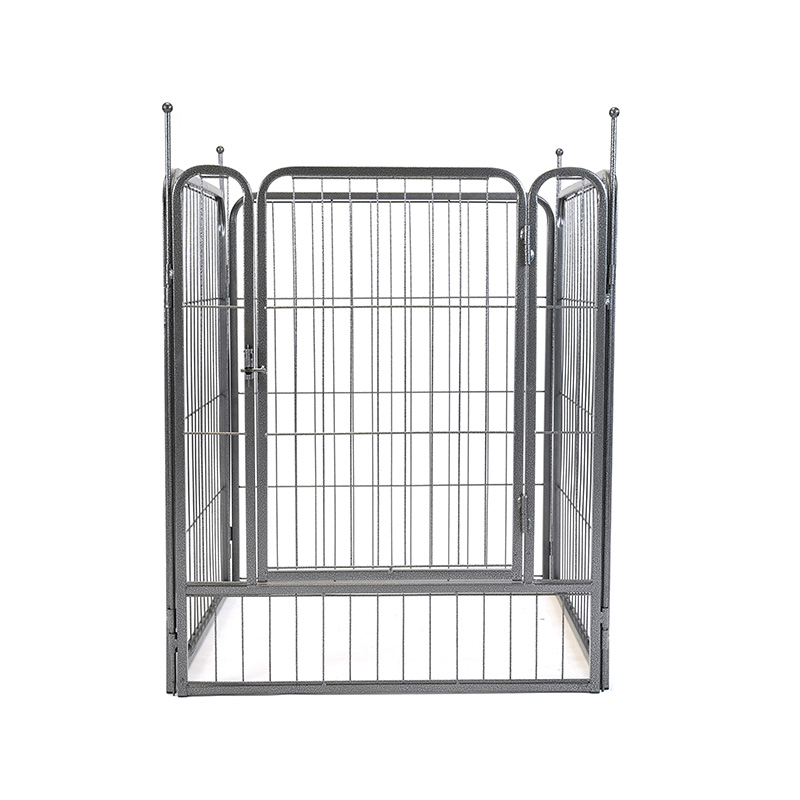 4-Panel Foldable Heavy Duty Pet Playpen for Small to Medium Dogs and CatsThis four-panel playpen offers a compact and portable solution for small to medium pets. It folds flat for storage and travel, while smooth edges and a safety lock help prevent injury and escapes, making it suitable for temporary indoor or outdoor use.View Product →
An 8-panel pet playpen is the recommended starting point for most owners, and it is also the most popular SKU in B2B orders from pet product importers.
Eight panels create more shape options than four: a 2.4 x 1.2 m rectangle, a 1.8 x 1.8 m square, or an L-shaped configuration that fits around a sofa or kitchen island. Depending on the panel dimension, the assembled area typically ranges from 3.5 to 6.4 square meters. Most heavy-duty 8-panel models in the market include a gate door, which lets a person walk in for cleaning or lets the dog exit without being lifted. This single feature changes the practical usability of the playpen in daily routines.
Suitable scenarios for an 8-panel playpen include:
For a medium dog in the 15-25 kg range, an 8-panel unit usually provides room to stand, turn, lie flat, and move a few steps within the enclosure. The owner still needs to provide daily walks and exercise outside the pen, but the playpen becomes a dependable safe zone rather than a cramped crate. The storage requirement is moderate: most 8-panel models fold into a flat footprint comparable to a large rug.
 8-Panel Heavy Duty Metal Outdoor Pet Playpen with DoorThis eight-panel metal playpen creates a spacious secure enclosure for outdoor use. Panels can be inserted into soil for stability without extra parts, and the foldable design with an easy-open door simplifies setup and storage for yards, camping, or temporary containment.View Product →
A 16-panel pet playpen is engineered for large yards, breeding operations, or households that need to partition one large space into several smaller pens.
When assembled as a single rectangle, sixteen panels enclose approximately 7 to 12 square meters, depending on panel width and the aspect ratio you choose. That is enough space for a large dog over 25 kg to move several meters, or for two medium dogs to share the run without crowding. The strength of the 16-panel configuration lies in its modularity: one kit can be split into two separate 8-panel runs. Breeders use this to separate weaning puppies, post-surgery animals, or dogs in heat while keeping them within one purchased set.
Best applications for a 16-panel playpen include:
The trade-offs are noticeable. A 16-panel set is heavier, occupies more storage space when folded, and takes longer to assemble and disassemble. It is also less suitable for indoor use unless the room provides at least 8-10 square meters of unobstructed floor. For most buyers, the 16-panel unit is not a first purchase; it usually arrives after a 4-panel or 8-panel has proven insufficient for the pet's growth.
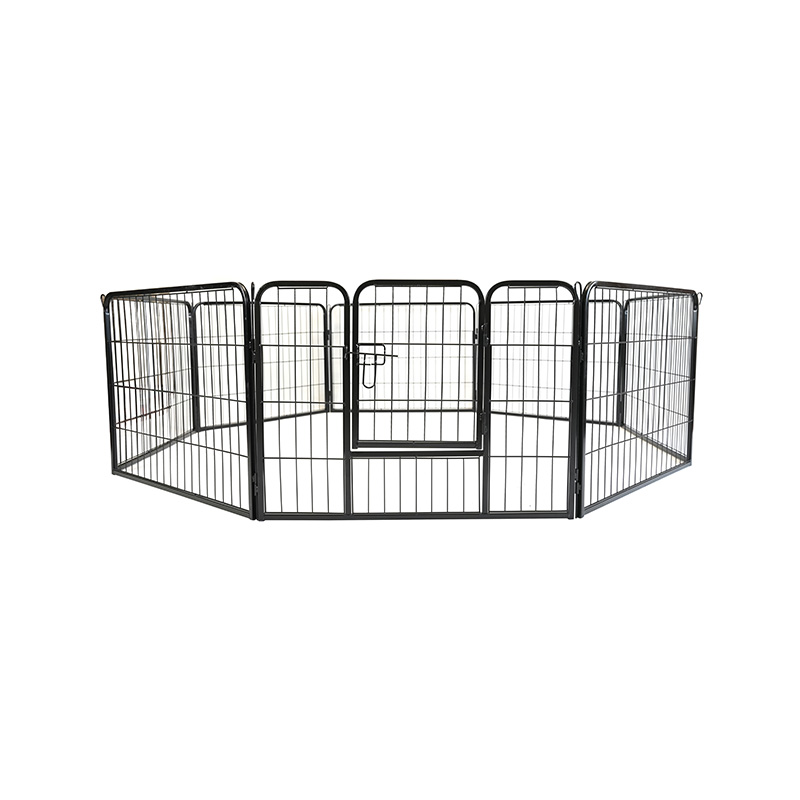 8-Panel Heavy Duty Metal Puppy Fence for Flexible LayoutsDesigned for puppies and small animals, this eight-panel fence features adjustable connections to form various shapes. It requires no special tools for assembly and provides sturdy containment while allowing enough room for exercise, indoors or in the yard.View Product →
Direct comparison helps buyers make faster decisions. The numbers below reflect common heavy-duty configurations where one panel is roughly 60 cm wide and 80-100 cm high.
| Configuration | Floor area | Shape options | Best weight range | Price tier |
| 4-Panel | About 1.2-1.5 m2 | Square | Under 10 kg | Entry |
| 8-Panel | About 3.5-6.4 m2 | Rectangle / L-shape | 10-25 kg | Mid |
| 16-Panel | About 7-12 m2 | Large rectangle or two pens | Over 25 kg | High |
Measure the exact floor space first, then buy the next size up from what you think you need.
The common mistake is to size a playpen to the current dog rather than to the adult dog. Puppies grow rapidly, furniture gets rearranged, and an enclosure that fits today will feel cramped in six months. Purchasing the next size up adds initial cost but avoids a second purchase. The extra panels also let you reshape the enclosure around a sofa, a door, or a wheeled furniture item without relocating the whole unit.
Follow this four-step process:
For a deeper breakdown of the process, our article on how do I choose the right pet playpen folding run for my pet walks through the same checks with actual panel dimensions and gate options.
B2B buyers should treat panel count as a product-lines decision rather than just a size decision.
When a wholesale client orders a mixed container, panel count influences the packaging dimensions, freight volume, and warehouse space required in the destination market. Importers who source from a single factory with 4, 6, 8, and 16 panel configurations simplify inventory planning because one supplier maintains one quality standard across all sizes. OEM requests for powder coating, panel height, gate placement, and tube thickness become easier to coordinate when the factory has a tracked quality process from raw material to finished product.
Nantong Dihang Metal Products Co., Ltd. is a professional pet product manufacturer and exporter based in Jiangsu, China, with over 100 models of pet cages and playpens. The company produces heavy-duty metal playpens in 4, 6, 8, and 16 panel configurations and supports OEM and custom solutions. Its documented process includes raw material testing, in-process checks, and final inspection of corrosion resistance and biting resistance, with third-party inspection aligned to SGS standards. For clients who want to understand the broader product landscape, the application scenarios for pet fences article covers how metal playpen configurations are used across different customer segments.
A 4-panel playpen creates roughly 1.2-1.5 square meters of floor area, while an 8-panel playpen expands to about 3.5-6.4 square meters. The larger unit also provides shape flexibility, allowing a rectangle, an L-shape, or two smaller pens with the same panels.
Yes, most manufacturers produce connector pieces that allow additional panels to be attached. Verify that the new panels come from the same series and share the same tube thickness, otherwise the connection may become loose. Ordering a matching extension kit directly from the factory is the safest route.
It is too large for most apartments, but it works well in basements, garages, and large open living areas. With about 8-10 square meters of unobstructed floor space, a 16-panel set can be reconfigured into two 8-panel pens, making it useful for multi-dog households.
Pricing scales with panel count, tube thickness, and the presence of a gate door. A heavy-duty 4-panel unit is roughly 40-60% cheaper than a comparable 16-panel, but per-panel costs fall because connectors and gates are shared across the set. For B2B buyers, mixed container orders typically balance the per-panel price around the 8-panel SKU.