
 Inquiry

 English
 中文简体
中文简体 Deutsch
- Type:
- Industry News
- Date
- 2026-Apr-02
Industry News
Why Is the Foldable Dog Cage the Smart Choice for B2B Buyers?
Content
The pet product market continues to grow, with demand for portable and space-saving solutions driving innovation. For manufacturers, wholesalers, and retailers, selecting the right product category requires understanding both consumer behavior and engineering specifications. Foldable dog cage products have become a staple in the industry because they address multiple user needs simultaneously. This article provides a technical analysis for B2B professionals, focusing on material selection, structural integrity, manufacturing consistency, and market trends that will shape procurement decisions.
The Market Shift Toward Portable Pet Housing
Urban living spaces are shrinking, and pet owners increasingly seek products that balance functionality with storage efficiency. A foldable dog cage offers the ideal solution by providing a secure enclosure that collapses to a fraction of its assembled size. For B2B buyers, this category represents consistent demand across multiple distribution channels. The long-tail keyword heavy-duty foldable dog cage for large breeds indicates a growing market segment focused on durability and size capacity. Similarly, the search for a portable foldable dog cage for travel and camping reflects the expanding outdoor and mobility segment of the market.
Structural Engineering: Frame and Joint Design
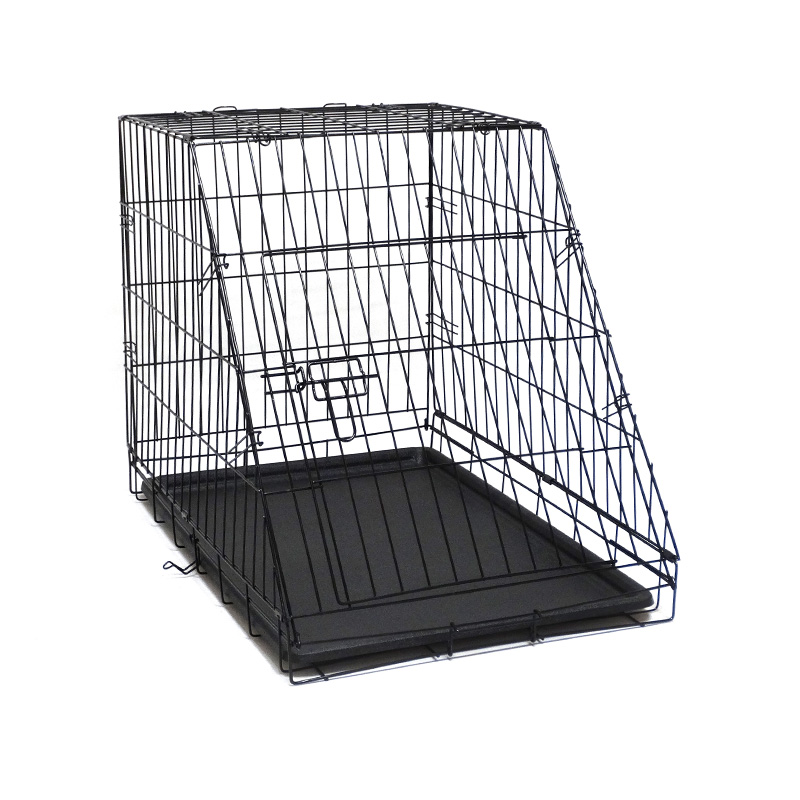
The core engineering challenge in a foldable dog cage lies in the hinge and locking mechanism. Premium products use either welded steel tube frames or heavy-gauge wire mesh construction. The folding mechanism typically employs either scissor-action hinges or panel-based folding systems. Engineers evaluate three critical points: cycle life of the hinges, lock engagement force, and frame stability under dynamic loads. For buyers sourcing heavy-duty foldable dog cages for large breeds, verifying that the frame uses 2.0mm to 2.5mm diameter steel tubing with a powder-coated finish ensures longevity.
Material Selection: Wire, Tube, and Coating Specifications
Material choice directly impacts product lifespan and safety. High-quality foldable dog cage units use either Q195 or Q235 carbon steel for frames. The wire gauge varies by application: 2.0mm to 2.5mm for small to medium breeds, and 3.0mm to 4.0mm for extra-large breeds. Coating systems are equally important. Electrostatic powder coating provides superior corrosion resistance compared to wet paint. The coating thickness should exceed 60 microns for rust protection. Additionally, buyers seeking a non-toxic foldable dog cage with a safe coating should verify that the coating is free from lead, cadmium, and other heavy metals, with certification such as EN71-3 for toy safety standards.
Comparative Analysis: Foldable vs. Traditional Fixed Cages
When evaluating product lines, B2B buyers need clear performance comparisons. Traditional fixed cages offer structural rigidity but lack storage efficiency. Foldable dog cage designs sacrifice some rigidity for portability, but advanced engineering minimizes this trade-off. The following table compares key specifications relevant to wholesale purchasing decisions.
.Mathematics: 80-120 lbs for large variants, 愈加Cost per Unit (Bulk Wholesale)
| Specification | Foldable Dog Cage | Traditional Fixed Cage |
|---|---|---|
| Assembly Time (First Use) | 2-5 minutes (pop-up or latch system) | 10-20 minutes (bolts and fasteners) |
| Storage Volume (Collapsed) | 15-25% of assembled size | 100% (non-collapsible) |
| Frame Material (Typical) | 2.0mm steel tube or 2.5mm wire | 1.5mm-2.0mm wire or plastic composite |
| Locking Mechanism Points | 4-8 latches depending on design | 2-4 latches typically |
| Max Recommended Weight Capacity | 60-100 lbs for comparable size | |
| Medium to Medium-High | Low to Medium |
Manufacturing Considerations for B2B Sourcing
For wholesalers and retailers, consistency across production batches is critical. The foldable dog cage category requires particular attention to hinge assembly and coating uniformity. When sourcing bulk foldable dog cages for wholesale distribution, buyers should request factory audit reports and test results for the following areas.
Key Quality Control Points
- Hinge Cycle Testing: The folding mechanism should withstand 3,000 to 5,000 open-close cycles without loosening or failure. Request test reports verifying cycle count.
- Locking Mechanism Strength: Each latch must hold a minimum of 50 kg of static force without disengaging. For large breed variants, this requirement increases to 80 kg per latch.
- Coating Adhesion: Cross-cut tape testing (ASTM D3359) should achieve a rating of 4B or higher, ensuring the powder coating does not peel or flake under normal use.
- Welding Integrity: All welded joints must show consistent penetration without sharp spatter that could injure pets or users. Visual inspection and pull testing should confirm weld strength.
- Pinch Point Assessment: The folding mechanism must be designed to prevent pinch points that could trap pet paws or human fingers during setup and takedown.
The long-tailkeyword-heavy-duty foldablee dog cage for large breeds typically requires reinforced corner brackets and double-locking door mechanisms. These features add manufacturing cost but command higher wholesale pricing and reduced return rates.
Material Safety Certifications
Safety certification has become a non-negotiable requirement for pet products entering regulated markets. B2B buyers should prioritize suppliers who can provide documentation for:
- EN 71-3: Migration of certain elements (heavy metals) for products entering European markets.
- ASTM F963: Standard consumer safety specification for toy safety, applicable to pet products in many jurisdictions.
- REACH Compliance: Declaration that all materials meet European chemical safety standards.
- Proposition 65 Compliance: Required for products sold in California, covering chemical exposure warnings.
For buyers specifically targeting eco-conscious consumers, the search for an eco-friendly foldable dog cage with recyclable materials has increased. This segment favors cages constructed with powder-coated steel (100% recyclable) and minimal plastic components, or those using recycled PET in the removable tray.
Design Variations and Market Segmentation
Understanding market segments helps B2B buyers optimize their inventory. The foldable dog cage category is divided into distinct usage-based segments:
Portability-Focused Design
These products prioritize lightweight construction and rapid setup. They typically use lighter-gauge wire (1.8mm to 2.2mm) and feature carrying handles or shoulder straps. The long-tail keyword portable foldable dog cage for travel and camping defines this segment. These units often include carrying bags and weigh under 8 kg for large sizes.
Heavy-Duty Stationary with Portability
This segment emphasizes security and durability while maintaining foldability for seasonal storage or moving. These units use thicker steel (2.5mm to 3.5mm), reinforced corners, and double-locking doors. The keyword heavy-duty foldable dog cage for large breeds aligns with this segment, which commands higher wholesale pricing but offers lower return rates due to superior construction.
Multi-Function and Furniture-Integrated Designs
Emerging designs incorporate the foldable dog cage into furniture pieces such as end tables or console units. These products require additional engineering for aesthetics and structural stability. The long-tail keyword furniture style foldable dog cage for home decor reflects this growing niche, appealing to consumers who want pet products that blend with interior design.
Logistics and Packaging Considerations
For B2B buyers, the foldability of these products creates significant logistics advantages. A standard 42-inch foldable dog cage collapses to approximately 10% of its assembled cubic volume. This allows higher container packing density and reduced shipping costs per unit. When sourcing bulk foldable dog cages for wholesale distribution, buyers should verify that packaging is optimized for pallet stacking and that cartons include clear assembly instructions in multiple languages for international distribution.
Frequently Asked Questions (FAQ)
- Q: What is the typical lifespan of a foldable dog cage under daily use?
A: A well-constructed foldable dog cage using 2.5mm steel tube and electrostatically applied powder coating typically lasts 5 to 8 years under daily use. The hinge mechanism is usually the first component to show wear, with quality units rated for 5,000 open-close cycles. - Q: How do I verify the safety of the coating on a foldable dog cage?
A: Request test reports for coating composition and adhesion. Safe coatings should be free from lead, cadmium, and phthalates. For products targeting safety-conscious consumers, specifically source a non-toxic foldable dog cage with a safe coating and request EN71-3 or ASTM F963 compliance documentation. - Q: What is the maximum size available in foldable dog cages?
A: Industrial manufacturers produce foldable dog cage units up to 54 inches in length for giant breeds such as Great Danes or Mastiffs. These heavy-duty variants use 3.5mm to 4.0mm steel wire and often include reinforced corner brackets. The keyword heavy-duty foldable dog cage for large breeds typically refers to units sized for 90 to 150 lb dogs. - Q: Can foldable dog cages be used for airline travel?
A: Most standard foldable dog cage units are not airline-approved for cargo travel due to their folding mechanisms. For air travel, buyers should source IATA-compliant travel crates. However, portable foldable cages are suitable for car travel, camping, and home use. For airline-approved options, search for an airline-approved foldable dog cage for cargo, which typically uses bolt-together construction rather than folding hinges.
References
- ASTM International, "Standard Consumer Safety Specification for Toy Safety," ASTM F963-23.
- European Committee for Standardization, "Safety of Toys - Part 3: Migration of Certain Elements," EN 71-3:2019+A1:2021.
- Journal of Materials Engineering and Performance, "Corrosion Resistance of Powder-Coated Carbon Steel in Pet Product Applications," Vol. 33, Issue 5, 2024.
- Pet Industry Joint Advisory Council (PIJAC), "Market Trends in Pet Housing and Containment Products," 2025 Annual Report.
- International Air Transport Association (IATA), "Live Animals Regulations (LAR) Container Requirements," 2026 Edition.
- American Society for Testing and Materials, "Standard Test Method for Measuring Adhesion by Tape Test," ASTM D3359-23.



Nantong Dihang Metal Products Co., Ltd.
Product Center
Contact Us
- +86-15262716185
- [email protected]
- Group 1, Guzhuang Village, Qutang Town, Haian Country, Nantong, Jiangsu, China
Copyright © 2023 Nantong Dihang Metal Products Co., Ltd. All Rights Reserved.
