
 Inquiry

 English
 中文简体
中文简体 Deutsch
- Type:
- Industry News
- Date
- 2026-Apr-08
Industry News
What Defines a Strong Metal Dog Crate for Heavy Duty Use?
Content
Introduction to Canine Containment Engineering
In the professional pet industry, the safety and security of animals are paramount. Veterinary clinics, professional trainers, and wholesale distributors require equipment that meets rigorous engineering standards. A strong metal dog crate is not simply a cage; it is a life-safety enclosure designed to withstand significant physical force. The market has shifted towards solutions that prevent escape and injury, specifically for dogs with behavioral challenges. Understanding the technical specifications of these units is essential for B2B procurement teams who need reliable inventory.
Material Specifications and Structural Design
The performance of a crate depends heavily on its raw material composition and manufacturing technique. Engineers design these units to resist biting, scratching, and impact.
Gauge Steel and Weld Integrity
The term "gauge" refers to the thickness of the metal wire or tubing used in construction. A lower gauge number indicates thicker, stronger steel. For a truly chew-proof dog crate for separation anxiety, manufacturers typically utilize 12 to 16-gauge steel. The thinner 20-gauge wire is insufficient for powerful jaw pressures. Furthermore, the weld points are critical failure zones. Spot welding is common, but professional-grade crates often feature full seam welding. This technique eliminates sharp edges and increases the structural integrity of the joints, preventing dogs from breaking the welds through persistent agitation.
Frame Construction and Load Bearing
The design of the frame dictates the overall stability of the unit. Tube frame construction provides a rigid skeleton that supports the wire mesh. This design ensures that the crate does not collapse if a dog jumps against the side. For a heavy-duty metal dog cage for large breeds, the frame must support the dynamic weight of the animal. Engineers calculate load-bearing capacities to ensure the crate can hold the dog's weight without deformation.
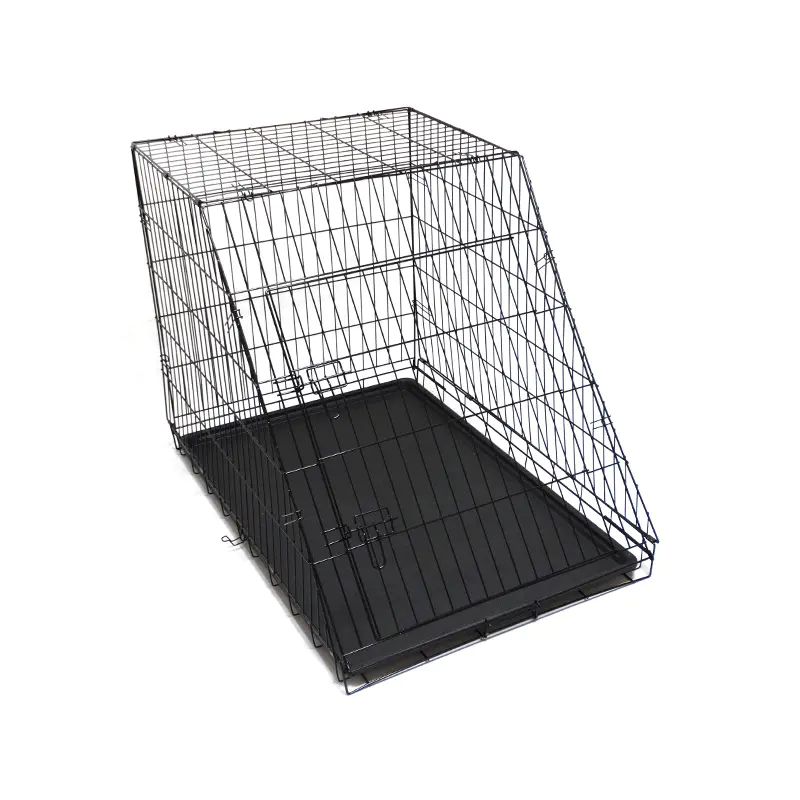
Comparative Analysis: Wire Gauge vs. Tubular Steel
Selecting the correct construction type is vital for matching the product to the consumer's needs. We compare standard wire crates with heavy-duty tubular models below.
| Feature | Standard Wire Gauge Crate | Heavy Duty Tubular Steel Crate |
| Primary Material | Wire Grid (18-20 gauge) | Steel Tubing + Reinforced Mesh (12-16 gauge) |
| Bite Resistance | Moderate | High (Difficult to grip and bend) |
| Weight | Lightweight (Easy to move) | Heavy (Stationary use preferred) |
| Assembly | Often foldable | Often requires bolt assembly |
| Target User | Trained dogs, Home use | Destructive dogs, Professional facilities |
Application Scenarios for B2B Procurement
Wholesale buyers must consider various use cases when selecting inventory. Different customers have distinct requirements for their enclosures.
Solutions for Large Breeds
Large dogs possess the strength to bend inadequate barriers. A heavy-duty metal dog cage for large breeds must feature reinforced doors and latches. The latch mechanism is a critical component. Engineers often design these crates with dual-locking systems to prevent intelligent dogs from manipulating the latch. The interior space must also allow for proper ventilation and thermoregulation, preventing overheating in larger animals.
Mobility and Logistics
Transportation of animals requires a balance between strength and portability. A foldable metal dog crate for travel addresses this logistical challenge. Manufacturers use hinge mechanisms that allow the crate to collapse flat without tools. However, the hinges must maintain their strength to avoid becoming weak points. Engineers focus on creating a "suitcase" folding style with secure handles, ensuring that the unit remains stable during transport.
Commercial and Home Integration
Modern consumers seek products that blend into their home environment. An industrial-strength dog kennel for the home often features a powder-coated finish. This finish serves a dual purpose: it protects the metal from rust and gives it a furniture-like appearance. These units are robust enough for commercial training centers but aesthetically pleasing for residential living rooms.
Accessibility and Ventilation
Airflow is a safety requirement for any containment system. A double-door metal dog crate improves ventilation by allowing cross-ventilation when both doors are open. It also provides easier access for placing the dog inside or cleaning the unit. The door design should feature horizontal bars to prevent climbing, while the side panels may use closer spacing to prevent paws from getting stuck.
Manufacturing Standards and Safety Compliance
Quality assurance is a non-negotiable aspect of B2B purchasing. Buyers should verify that products meet international safety standards.
- Surface Treatment: Powder coating is superior to chrome plating for durability and toxicity reduction.
- Edge Safety: All metal edges must be rolled or ground to prevent cuts.
- Non-Toxic Materials: Coatings must be lead-free and safe for animals to lick.
- Rust Resistance: Anti-corrosion treatments are essential for longevity.
Conclusion
Procurement professionals must look beyond price points and evaluate engineering quality. A strong metal dog crate provides essential value through durability, safety, and escape prevention. By understanding material gauges, weld types, and latch mechanisms, buyers can source products that truly meet the demands of powerful dogs and professional environments.
FAQ
Is a metal crate better than plastic for travel?
It depends on the mode of transport. Metal crates provide better ventilation and security for destructive dogs. However, plastic crates are often required for air travel cargo due to airline regulations.
How do I clean a heavy-duty metal crate?
You should use a non-toxic disinfectant and a hose. The powder-coated surface resists stains, making it easy to wipe down. A removable tray at the bottom simplifies the cleaning of waste.
Can a dog break out of a wire crate?
Yes, determined dogs can bend light-gauge wire crates. This is why industry experts recommend tubular steel or heavy-gauge construction for dogs with separation anxiety or high strength.
What size crate do I need for a large breed?
The dog should be able to stand up straight without touching the top. They should also be able to turn around comfortably. Measure the dog's height and length before selecting a crate size.
References
- ASTM F2798 - 18, Standard Specification for Dog and Cat Enclosures.
- Centers for Disease Control and Prevention. "Guidelines for Importing Dogs."
- International Air Transport Association (IATA). "Live Animals Regulations (LAR)."
- Journal of Veterinary Behavior. "Stress reduction in confined canines."
- American Society for Testing and Materials. "Standard Terminology for Kennel Equipment."



Nantong Dihang Metal Products Co., Ltd.
Product Center
Contact Us
- +86-15262716185
- [email protected]
- Group 1, Guzhuang Village, Qutang Town, Haian Country, Nantong, Jiangsu, China
Copyright © 2023 Nantong Dihang Metal Products Co., Ltd. All Rights Reserved.
