 Inquiry

 English
 中文简体
中文简体 Deutsch
- Type:
- Industry News
- Date
- 2026-Oct-12
News
Home / News / Industry News / ABS Tray vs Plastic Tray vs Iron Tray: Which Pet Cage Tray Is Best for Dogs?
Content
A 42-inch heavy-duty dog crate produced with an ABS tray costs roughly 4 to 6 percent more than the same crate fitted with a stamped iron tray. On a quotation that looks like a rounding error. In a retail account's first year of returns, that gap is usually what decides how many tray-related claims come back.
The tray is the one part of a metal pet cage that holds urine, spilled water, kibble, and the full downward load of a dog standing on one paw. Any serious ABS tray vs plastic tray vs iron tray comparison has to be made on those terms, not on which material sounds more expensive. Nantong Dihang Metal Products Co., Ltd., a pet cage and pet playpen manufacturer and exporter founded in 2015 with more than 100 crate and playpen models in its catalog, builds heavy-duty crates with all three tray types, so this comparison comes from the production floor rather than from a materials textbook.
Decision rule
Choose the tray by the failure mode you cannot afford. Chew-through points to iron, rust through a scratched coating points to ABS, and cracking under a dropped carton points to iron or a thick-wall ABS.
ABS is a styrene-based engineering thermoplastic, the generic plastic tray in most pet cage catalogs is polypropylene, and an iron tray is a stamped steel pan finished with powder coating.
ABS, short for acrylonitrile butadiene styrene, is a terpolymer. Acrylonitrile contributes chemical resistance, butadiene contributes impact toughness, and styrene contributes the smooth molded surface. Injection-molded ABS trays for a 42-inch crate usually run 2.5 to 3.5 mm at the wall, with 3 mm or more through the corner radius, which is why importers treat it as the premium option rather than the default.
Polypropylene, or PP, is the workhorse. It is lighter and cheaper than ABS and resists most household chemicals, but it is softer and far more sensitive to stress concentration. A PP tray on the same 42-inch crate is typically 1.5 to 2.5 mm thick, and the corners are where it fails first.
Iron trays are stamped from 0.6 to 0.8 mm cold-rolled steel, formed with a raised rim, and powder coated at 60 to 90 microns. It is the oldest design in the category and still the strongest per millimetre of thickness.
Definition
A pet cage tray is the removable floor pan that sits beneath the wire mesh and collects waste, water, and bedding. Its material sets the crate's practical load rating, its corrosion behaviour, and the end user's cleaning routine.
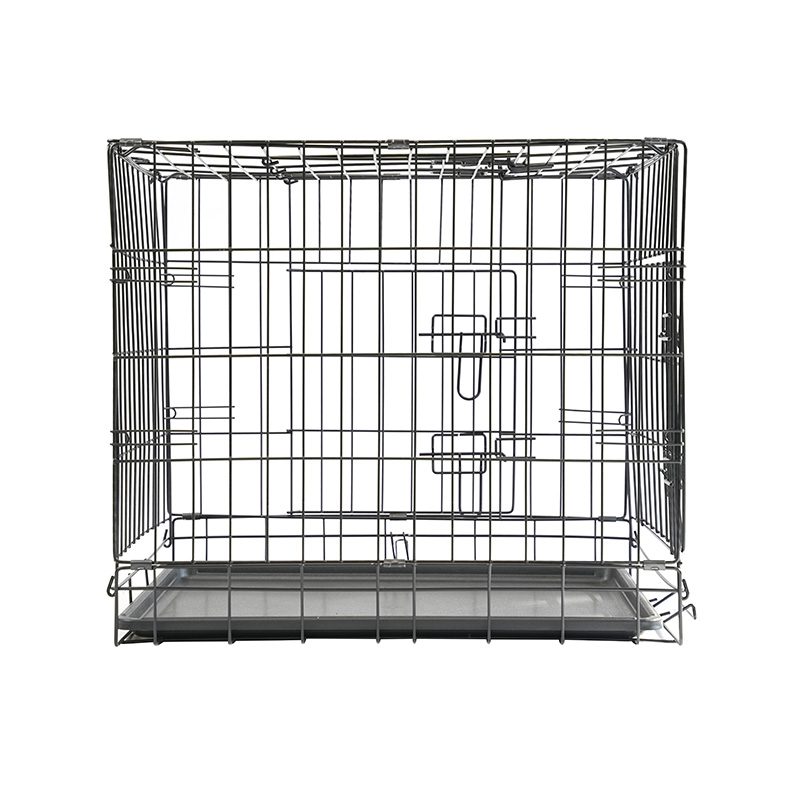
One production example of the molded approach is the DH1202 heavy-duty metal dog cage with ABS tray, which pairs a reinforced wire frame with a molded pan sized for the same load assumptions.
Iron wins on load capacity and chew resistance, ABS wins on corrosion resistance and cleaning, and polypropylene wins on cost and weight. No single tray leads in all three categories, which is why the choice has to be tied to a specific sales channel.
| Property | PP tray | ABS tray | Iron tray |
| Typical wall thickness | 1.5 to 2.5 mm | 2.5 to 3.5 mm | 0.6 to 0.8 mm steel plus coating |
| Static load before permanent set | about 25 kg | about 45 kg | 90 kg and above |
| Chew resistance | Low | Medium | High |
| Corrosion after a scratch | None | None | Rust in days if left wet |
| Odour absorption | Noticeable over time | Very slight | None, but coating edges trap residue |
| Tray weight, 42-inch | about 1.1 kg | about 1.6 kg | about 2.3 kg |
| Relative unit cost index | 100 | 135 to 150 | 110 to 125 |
| Cleaning routine | Wipe, air dry | Wipe, air dry | Scrub, dry fully before refitting |
Read the cost index carefully. At volume, the iron tray is not the expensive option; the ABS tray is. ABS carries both the premium price and the premium claim rate, because buyers who pay for ABS expect it to survive everything their customer's dog does to it.
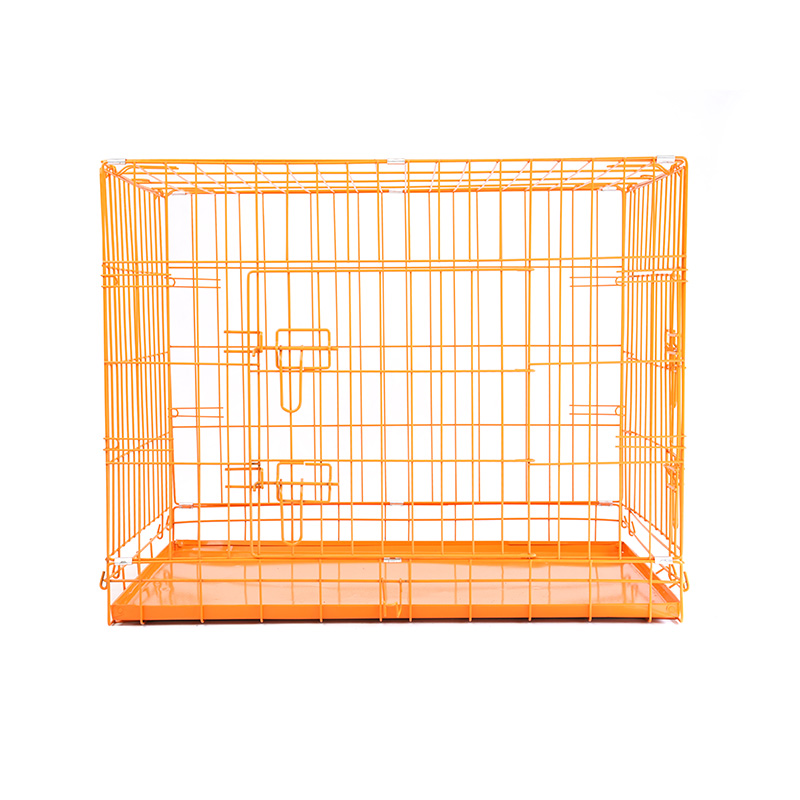
For heavy-duty builds where chewing and load are the binding constraints, an iron-tray crate such as the DH0164 two-door iron tray metal pet cage is the safer specification.
On a 42-inch crate, the tray, not the wire gauge, is usually what fails first when a large dog jumps in.
Static load before permanent deformation, 42-inch tray
Values assume the tray is supported on its full rim at room temperature.
The numbers behave predictably. A 3 mm ABS pan supported on its full rim deflects less than 5 mm under 45 kg at room temperature. A 1.8 mm PP pan starts showing stress whitening at the corners above roughly 30 kg. A 0.7 mm powder-coated iron pan carries 90 kg or more without taking a permanent set. Those figures assume rim support; once a warehouse stacks crates on their sides, the load path changes and PP corners crack within a season.
Heat matters as much as weight. A crate left in a parked van or a sunny container can reach 60 C inside. ABS holds its shape to about 90 C. PP softens from roughly 90 C but creeps under load well below that, so a heavy dog standing on a warm PP tray can leave a permanent dish in the pan. Iron is unaffected by any temperature a pet product realistically sees, but it transmits noise and feels colder to the dog unless bedding sits on top.
Cleaning then separates the three in a different way. ABS has the least porous surface and releases urine and food residue with a wipe. PP holds micro-scratches and slowly takes on odour. Powder-coated iron cleans just as easily until the coating is scratched, after which moisture sits against bare steel.
Match the tray to the failure mode that drives claims in a given channel, not to the price tier printed on the packaging.
Retail starter kits
High-volume pet specialty chains sell on price and shelf appeal. PP trays keep the landed cost down, provided the wall is at least 2 mm and the corner radius is 8 mm or more. Below that, corner cracking becomes the top return reason.
Breeders and veterinary channels
These buyers clean trays daily with disinfectant and complain about odour first. A 2.8 to 3.5 mm ABS tray resists chemical attack, wipes clean, and keeps its appearance through years of scrubbing.
Large-breed and outdoor use
Chewing and static load decide the specification. A 0.7 mm powder-coated iron tray at 70 microns survives dogs that destroy plastic pans in weeks, and it does not dish under a 50 kg dog.
Most importers run two tray materials in a single catalog and sometimes three. The entry SKU takes PP, the mid and premium SKUs take ABS, and the large-breed, outdoor, and transport SKUs take iron. Splitting the range that way keeps the retail price ladder intact while putting the material where the customer will actually notice the difference.
In a custom crate program, the tray is almost always the longest lead-time item, not the wire frame or the latch.
Injection tooling for a new PP or ABS tray takes 25 to 35 days, and colour changes are cheap because masterbatch is added at the press. Iron trays need a stamping die plus a slot on the coating line. Their per-unit cost falls faster at volume, but every colour change is a separate powder batch and every batch needs its own adhesion and salt spray check.
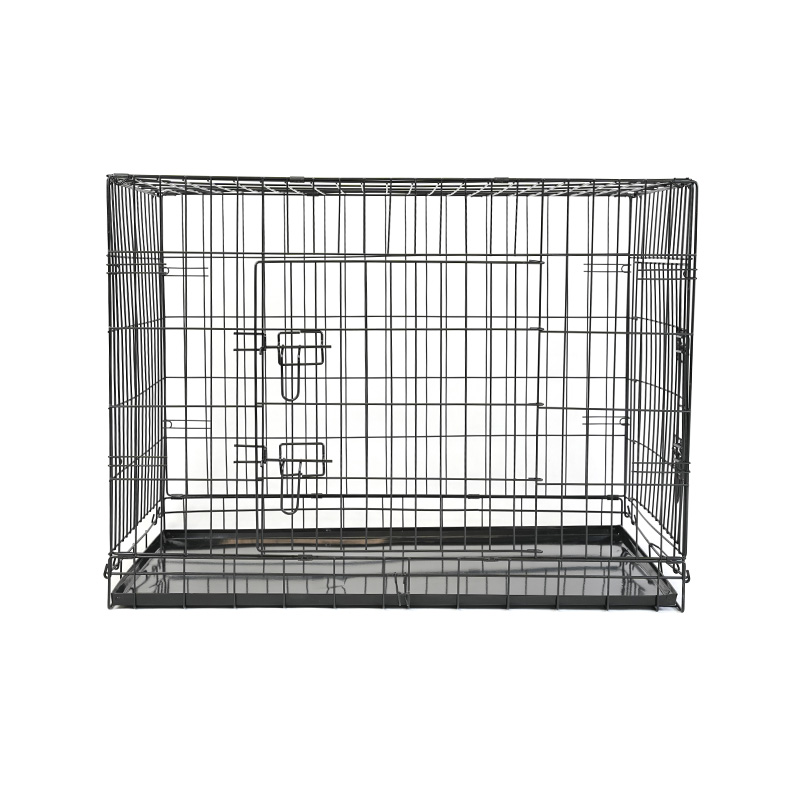
Tooling economics decide the rest. A tray mold is amortised across the order, so a 500-piece trial carries a far higher per-unit cost than a 5,000-piece program. Three tray sizes in two materials means six tools, and the quotation will show it. Where the target price is tight and the dog is medium-sized, a plastic-tray build such as the DH1212 heavy-duty foldable kennel with plastic tray keeps both the unit weight and the landed cost down.
Five failure modes account for almost every tray-related claim, and all five are visible in a 20-minute sample inspection.
Coating integrity is the whole game on iron trays. A 0.5 mm scribe that reaches bare steel becomes a rust bloom in under a week in humid shipping conditions, which is why rust prevention on metal pet cages deserves its own line in the sample checklist rather than a footnote.
It depends on the failure mode you are protecting against. ABS is better against corrosion, odour, and weight, and it is roughly 30 percent lighter. Iron is better against chewing and static load. If dogs in the target market chew their crates, iron wins. If crates ship into humid coastal markets and are cleaned daily, ABS wins.
Thin polypropylene trays do. A 1.5 mm PP pan shows corner whitening from roughly 30 kg of concentrated static load, and a 45 kg dog landing on a corner hits harder than that. A 2 to 2.5 mm PP tray with an 8 mm corner radius handles most medium-breed programs; above 30 kg, move to ABS or iron.
ABS. Its molded surface is the least porous of the three, so urine and food residue wipe off without soaking. Powder-coated iron cleans just as easily while the coating is intact, but a scratch traps moisture and needs spot repair. Polypropylene holds micro-scratches and slowly retains odour.
Yes, and most importers do. A single container often carries a cost-driven PP SKU for entry-level retail alongside an ABS or iron SKU for premium shelves. The constraint is tooling: every tray size and material combination needs its own mold or stamping die, so mixing at the low end of a size range raises the per-unit cost.