 Inquiry


 English
 中文简体
 Deutsch
- Type:
- Industry News
- Date
- 2026-Nov-02
News
Home / News / Industry News / How to Choose the Right Metal Pet Cage for Your Dog: Sizing Before Looks
Content
A metal crate that fits an eight-week-old puppy becomes a cramped box by month six. That single mistake sits behind most of the bar chewing, tray digging and overnight escapes reported by owners, which is why sizing has to come before brand, price or finish when you choose the right metal pet cage for your dog.
Containment shape changes behavior too. A dog that can stand, turn fully and lie flat without pressing against three walls settles faster and vocalizes less. A dog wedged into a crate one size too small develops coping habits within weeks, and those habits usually outlast the crate itself.
A metal pet cage is a rigid enclosure built from welded wire or square steel tube, fitted with a removable tray floor and at least one locking door. It is containment equipment for sleep, travel and short-term management, not a replacement for exercise or social contact.
Buy the crate that fits the adult dog, not the puppy standing in front of you. Measure the dog nose to tail while it stands naturally, add 3 to 4 inches of interior length, and confirm the interior height clears the top of the head by at least 2 inches when the dog is standing upright.
Measure while standing. Run a tape from the tip of the nose to the base of the tail, with the dog on a level floor and not curled up. Add 3 to 4 inches for turning room.
Measure height at the skull. Measure from the floor to the top of the head in a standing position, then add 2 inches so the dog can sit upright without ducking.
Check the door and the tray. The door opening should let the dog walk in without lowering its head, and a tray with a rim of 2 inches or more keeps spilled water and bedding inside the crate.
Buy for the adult. A puppy crate purchased at final adult size needs a divider panel for the first months, otherwise house training regresses and the dog learns to soil its sleeping area.
| Crate size | Interior length | Typical adult weight | Common profiles |
| 24 inch | 22-24 in | Up to 20 lb | Chihuahua, Yorkshire Terrier, Papillon |
| 30 inch | 28-30 in | 20-30 lb | French Bulldog, Shih Tzu, Miniature Schnauzer |
| 36 inch | 34-36 in | 30-50 lb | Beagle, Border Collie, Pembroke Welsh Corgi |
| 42 inch | 40-42 in | 50-70 lb | Boxer, Australian Shepherd, Labrador female |
| 48 inch | 46-48 in | 70-110 lb | Golden Retriever, German Shepherd, Rottweiler |
Weight tables are a filter, not a verdict. A tall, narrow dog such as a Greyhound or a Doberman can outgrow a 42 inch crate by height while sitting well under the weight band, so height measurement always overrides the weight column.
Two 70 lb dogs can need completely different cages. A calm sleeper is fine in a standard wire model, while a dog that paws at the door, leans on the front panel or works the latch with its muzzle needs heavier wire, stronger welds and a latch built to resist a nose.
Four specifications separate a genuinely heavy duty cage from a marketing claim:
Push the front panel with a flat palm. If the bars deflect more than about 3/8 inch, or you hear welds ticking, the crate is not heavy duty, whatever the description says.
Dogs that habitually lean on the door or dig at the tray benefit from a reinforced crate with a solid tray and a two-door layout. One model in that class is the DH1202 heavy duty metal dog cage with ABS tray, built for large dogs that test the structure every day.
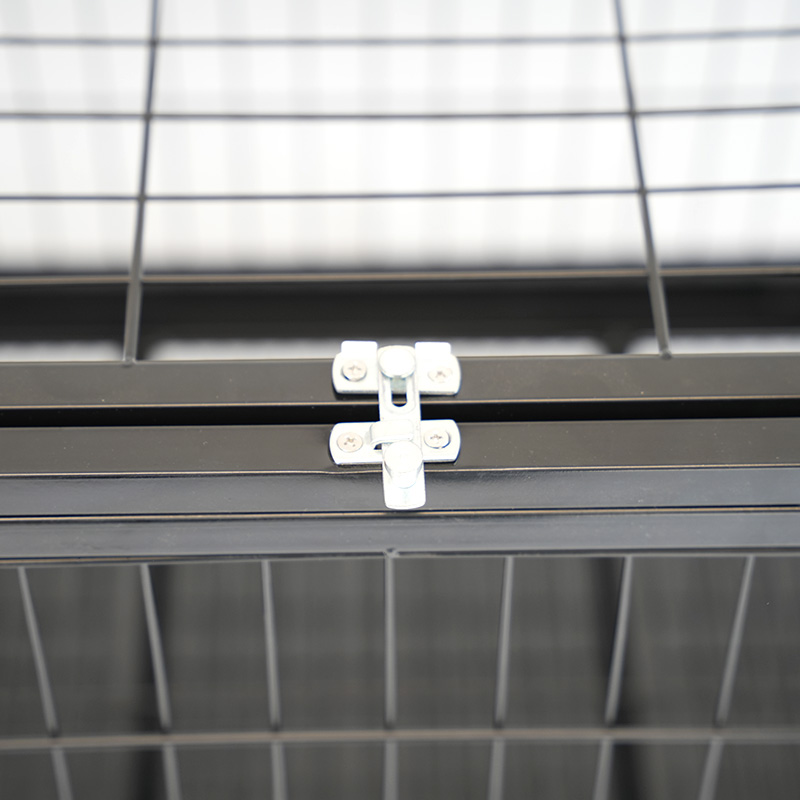 DH120-2 Heavy Duty Metal Dog Cage Pet Crate With Abs TrayDH120-2 Heavy Duty Metal Dog Cage Pet Crate With Abs Tray is a durable cage designed for pet dogs. It combines the stability of metal structure with the easy cleanabil...View Product →
If your dog is confined for more than four to six consecutive daytime hours, a cage alone is the wrong answer. A crate plus a metal playpen gives the dog a sleeping den and a separate activity zone, and that split removes most of the pressure that produces cage-related behavior problems.
Panel count drives usable floor area. With standard 24 inch panels, an 8-panel playpen encloses roughly 19 square feet, enough for a Labrador to stretch out and turn; a 4-panel unit at the same panel width is a travel barrier rather than a daytime home.
For mixed indoor and outdoor routines, a six-panel heavy duty playpen with a walk-through door covers the gap between crate naps and free roam in the yard, and it folds flat for storage in a garage or closet.
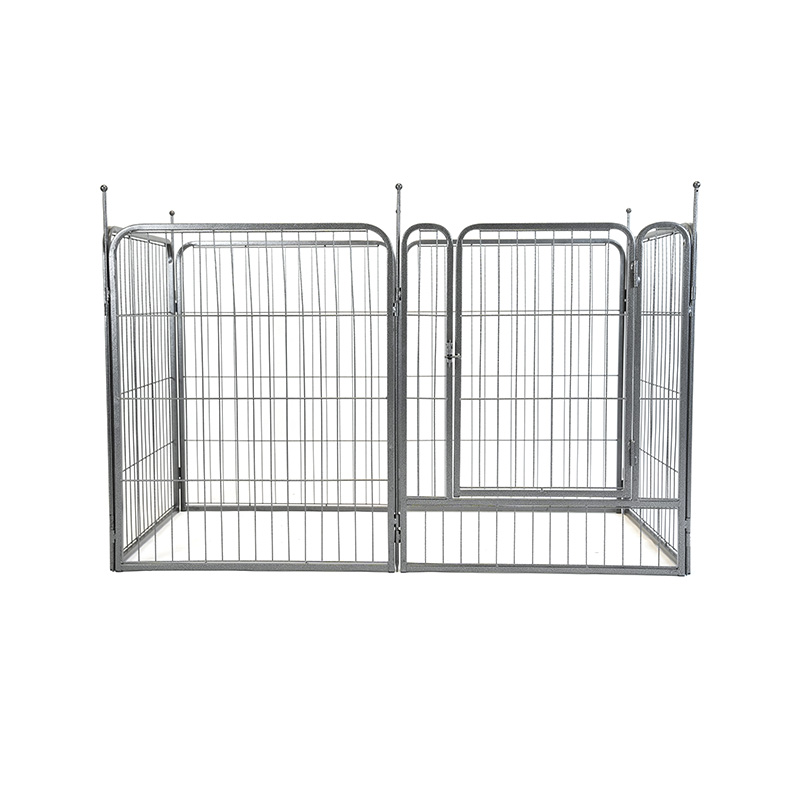 DH093-0 6 Panels Heavy Duty Pet Playpen Outdoor Dog FenceDH093-0 6 Panels Heavy Duty Pet Playpen Outdoor Dog Fence is a high-quality outdoor fence designed for pets. This product adopts a six-panel structure with excellent d...View Product →
Rust, bent bars and failed latches cause most early cage replacements, and all three trace back to build details you can inspect before buying rather than after. The five items below account for nearly every premature failure in metal dog cages.
Material choice drives most of those outcomes, so it is worth studying a detailed metal pet cage material selection breakdown before you finalize a purchase order or write a supplier specification.
Rust almost always starts in two places: the tray rim and the welds where the floor frame meets the side panels. Wiping both weekly with a damp cloth and drying them completely adds years to a cage that would otherwise be replaced in three seasons.
An inclined top cage removes the flat roof surface where dust, hair and moisture collect, and the added headroom lets a tall dog stand without crouching inside the frame.
For large dogs kept indoors in smaller rooms, that geometry is worth the extra cost. A 42 inch inclined dog crate delivers standing headroom in the same footprint as a standard flat-top model while simplifying the weekly clean.
 DH016XM-4 42 Inch Inclined Dog Pet Crate CageThis pet cage is suitable for the training, living and safe transportation of medium and large dogs. It measures 42 inches, providing ample space for pets to move free...View Product →
For wholesale buyers, the crate specification matters less than the process behind it. Test records, third-party inspection and sample-to-production consistency decide whether a container arrives sellable or becomes a claim.
Nantong Dihang Metal Products Co., Ltd. manufactures and exports metal pet cages and playpens for importers and brand owners, with more than 100 cage and playpen models covering standard, heavy duty and inclined builds, plus OEM programs and inspection support documented through to SGS certification.
Bulk buyers can review the full catalogue and request samples through the manufacturer's product range before committing to a container order.
Buy the size your puppy will reach as an adult, then block off the extra space with a divider panel. This keeps the sleeping area small enough for house training while avoiding a second crate purchase at eight months.
Metal cages win on ventilation, visibility and cleaning because the tray slides out and air moves through all four sides. Plastic kennels are lighter for air travel, but they hold heat and odor and are harder to inspect for cracks.
Switch to 8 to 10 gauge wire with fully welded joints, increase daily exercise, and give the dog a longer-lasting chew item inside the crate. Bar chewing usually signals boredom or a crate that is too small for the dog to turn around in.
For a healthy adult dog, four to six consecutive daytime hours is a practical ceiling, with a break for exercise and elimination. Overnight sleeping hours are separate. Puppies need much shorter intervals based on age.